Gravity without singularities
Sunday, July 17, 2011The existence of spacetime singularities in Einstein’s theory of General Relativity has long troubled physicists. Subramanyan Chandrasekhar was a young researcher when, at the age of 19, he proposed that very massive stars, after exhausting their fuel, would not be able to support themselves against gravity and would collapse. As a result a black hole would eventually form and a singularity, a point in spacetime where the classical laws of physics break down, would develop in its interior. Sir Arthur Eddington was a fierce opponent of this idea, “there should be a law of Nature to prevent a star from behaving in this absurd way!”, he once claimed. In the many decades since the dispute with Eddington, Chandrasekhar’s ideas prevailed and gave rise to a beautiful theory of compact stars and black holes. Nevertheless, echoes of Eddington’s arguments persist in the existence of singularities and physicists found this so hideous that in 1969 Sir Roger Penrose proposed his famous Cosmic Censorship Conjecture to save classical General Relativity.
In a Physical Review Letters we have demonstrated that a new theory of gravity does not show any of these undesirable features. In this intriguing theory singularities are not necessarily the outcome of gravitational collapse because, at ultra-high densities, a new “repulsive gravitational force” appears. As a bonus, the theory also predicts the existence of “dark matter stars”, compact stars which are invisible to telescopes, but contribute to the dark matter content of our Galaxy. Oddly enough, this new theory goes back to an idea proposed in 1924…by Eddington!
Press Releases
this link
Ines Valente, Equipa do IST sugere nova forma de matéria escura,
Ciencia Hoje
Computing time at the Barcelona Supercomputing Center (BSC)
Monday, July 11, 2011Our team has been granted 100k CPU hours at the MareNostrum supercomputer (Barcelona, Spain) for project “Black hole dynamics in alternative theories of gravity” (PI Helvi Witek).
The project “Numerical simulations of black-hole dynamics for use in experiment and observation” (PI Ulrich Sperhake, Co-Is: Andrea Nerozzi, Priscilla Canizares and Carlos Sopuerta) has been granted 300k CPU hours through the Barcelona Supercomputing Center (BSC).
Visit at Caltech
Thursday, July 7, 2011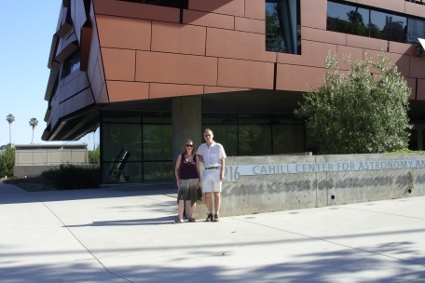
Helvi and Uli visited the TAPIR group at Caltech this June.
Helvi has given a TAPIR seminar on “Black hole collisions in higher dimensional spacetimes”.
NR/HEP workshop in Madeira
Friday, June 3, 2011
We are organizing an exciting workshop on the interface between numerical relativity and high energy physics. The aim of this workshop is to bring together world experts in two extremely active and successful, but up to now essentially disjoint, research fields: numerical relativity and high energy physics. More specifically, within high energy physics we shall focus on the gauge gravity duality and trans-Planckian scattering. The main motivation for this interdisciplinary effort is that it has become clear that numerical relativity techniques, applied to black hole systems, could answer central questions concerning dynamical processes in these high energy physics topics. Such techniques, which only very recently have reached a state of sufficient maturity, seem moreover mandatory for an accurate phenomenological modelling within these high energy physics scenarios. These facts, together with the ongoing scientific runs at the LHC, make this workshop very timely.
Sperhake gets successful evaluation of CIG grant
Wednesday, May 18, 2011Ulrich Sperhake has received a positive evaluation of his Marie Curie CIG grant and has been officially invited to negotiate the grant with the EU. Congratulations Uli!